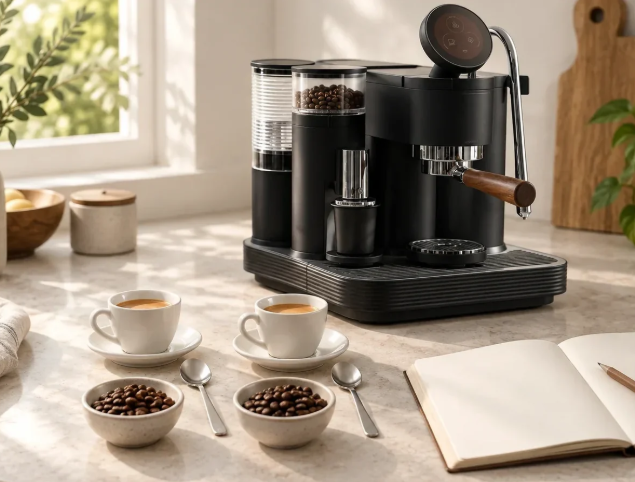

The smell of fresh coffee wafting from the kitchen is one of the best simple pleasures there is, especially when it matches the best in the area café. Achieving this commercial-grade quality at home requires more than just high-end beans; it demands a clear understanding of your hardware and home espresso brewing fundamentals. It is imperative to understand your machines and how home espresso brewing works. Semi automatic machines offer the best balance of skill and automation, providing an opportunity for enthusiasts to be actively involved in the creation process. In contrast to the super automatic machines which take care of everything within themselves, semi-automatic machines require grinding, dosing, tamping and extraction to be done manually. This allows for the complete freedom of controlling such factors as weight, time and quantity of extraction, based on individual preferences. Knowing the mechanisms of such multifunctional appliances will help in breaking down the whole process of brewing coffee into comprehensible actions.
Importance of Correct Dosing and Tamping Procedures
All great espresso shots begin from precise preparation, when the grind quality and tamping uniformity play a key role. Fresh roasted coffee beans should always be ground to the required consistency in accordance with the atmosphere conditions and aging process. After grinding, coffee is weighed and evenly distributed in the portafilter basket in order to avoid density discrepancies. Tamping process compresses loose coffee into a stable puck that can withstand pressurization of water and not fall apart. In case of improper tamping process, water will find its way through weak spots, causing too early channeling, under-extraction, and sour coffee taste profile. Development of this physical process of coffee and tamping interaction creates necessary skills of a good barista and impacts body, crema and flavor clarity. This physical and tactile interaction of the user with ingredients is the key factor which makes semi-automatic brewing so unique and fascinating.
Thermal Control and Maintenance of a Uniform Water Temperature
The maintenance of water temperature is perhaps the most important technical parameter in making a good espresso extraction, deciding which taste compounds will actually make it to your cup. The temperature that is too high causes burning of the precious oil in the coffee beans and produces very strong and bitter taste, that hides all other natural tastes of the beans. The water temperature that is too low does not allow the process of extraction to finish, and the taste becomes quite sour and bitter without any body and complexity. Nowadays, semi-automatic machines have heating devices, PID controllers and thermal stability parameters that keep the temperature of brewing water in strict limits. This control allows extraction of light, medium and dark roast with their respective optimal thermal parameters, that preserves distinctive fruity, floral and chocolate flavors. This thermal system explains the need in a good semi-automatic espresso machine.
Fluid Dynamics & Extraction Pressure Profiles
Espresso extraction is made possible by water pressure, which turns compacted coffee grounds into a flavorful shot of espresso topped with beautiful crema. The pressure of the water, delivered by a specially designed pump, forces the water through the coffee puck. The process guarantees proper emulsification of soluble solids, lipids, and gases, thus ensuring the characteristic heavy-bodied nature of espresso. The user controls the flow rate, watching the transition of the dark-colored flow into honey-like liquid. Such careful monitoring allows for proper control of extraction yield, avoiding over-extraction and extraction of the maximum amount of desirable solubles. Delving deeper into the science of espresso extraction makes one understand how small changes in flow rate and pressure profile affect taste, strength, and body of the beverage.
Achieving Excellence in Milk Texturing for Latte and Cappuccino
Drinks As a fan of milk-based coffee beverages such as latte and cappuccino drinks, learning to handle the steam wand is an indispensable part of your training to be a competent barista. After you pull the espresso, the steam system in your machine will produce steam with very high pressure that heats up and aerates the milk at the same time. Milk texturing consists of adding air to the milk in its first stage of stretching to form microfoam and then adding a rolling action to improve its texture. In this way, the milk will be broken down into billions of tiny bubbles making its surface look shiny and giving it a sweet taste. By pouring this microfoam into your espresso, you can decorate your drink with unique latte art.
Using the Right Equipment
To choose the right equipment to place on your kitchen countertop is an important achievement which determines how you will be preparing your daily cup of coffee in the coming years. Comprehensive educational resources, such as a detailed espresso machine guide, provide the clarity needed to make informed purchasing decisions. Pump types, boiler arrangements, and maintenance processes are explained in detail in these educational materials. You will learn how to maintain your machine through backflushing, group head cleaning, and descaling. With the combination of theoretical and practical knowledge, you will improve your ability to prepare coffee at home. It will become an art of using the semi-automatic espresso machine. Enjoy preparing coffee just as professionals do.